
Pothole Suspension Damage: Signs Northern Virginia Drivers Should Check
We are an auto repair shop serving Northern Virginia, and every year from late winter into spring we see the same pattern: a run of cars with suspension problems that all trace back to a specific pothole the owner still remembers hitting.
The frustrating part is that pothole suspension damage is frequently invisible. You hit something hard, the car seems fine, you carry on, and the consequences show up weeks later as a worn tyre, a pull to one side, or an alignment that will not hold.
This article covers what to check straight away, what to watch for over the following weeks, and which symptoms mean stop driving.
Why Northern Virginia potholes are worse than average
The mechanism is freeze-thaw cycling, and this region gets a lot of it.
Water seeps into small cracks in the road surface. When temperatures drop below freezing overnight, that water expands as it turns to ice and widens the crack. When it thaws during the day, the water drains away and leaves a void beneath the surface. Traffic then collapses the weakened section.
Northern Virginia’s winters swing across the freezing point repeatedly rather than staying reliably cold, which produces far more of these cycles than either a consistently cold or a consistently mild climate would. That is why the pothole season here is so pronounced from February through April.
Route 7, the Fairfax County Parkway and the older residential streets across Vienna, McLean and Reston are consistently among the worst by late winter. Add heavy commuter volume on those routes and defects open up quickly.
What pothole suspension damage actually affects
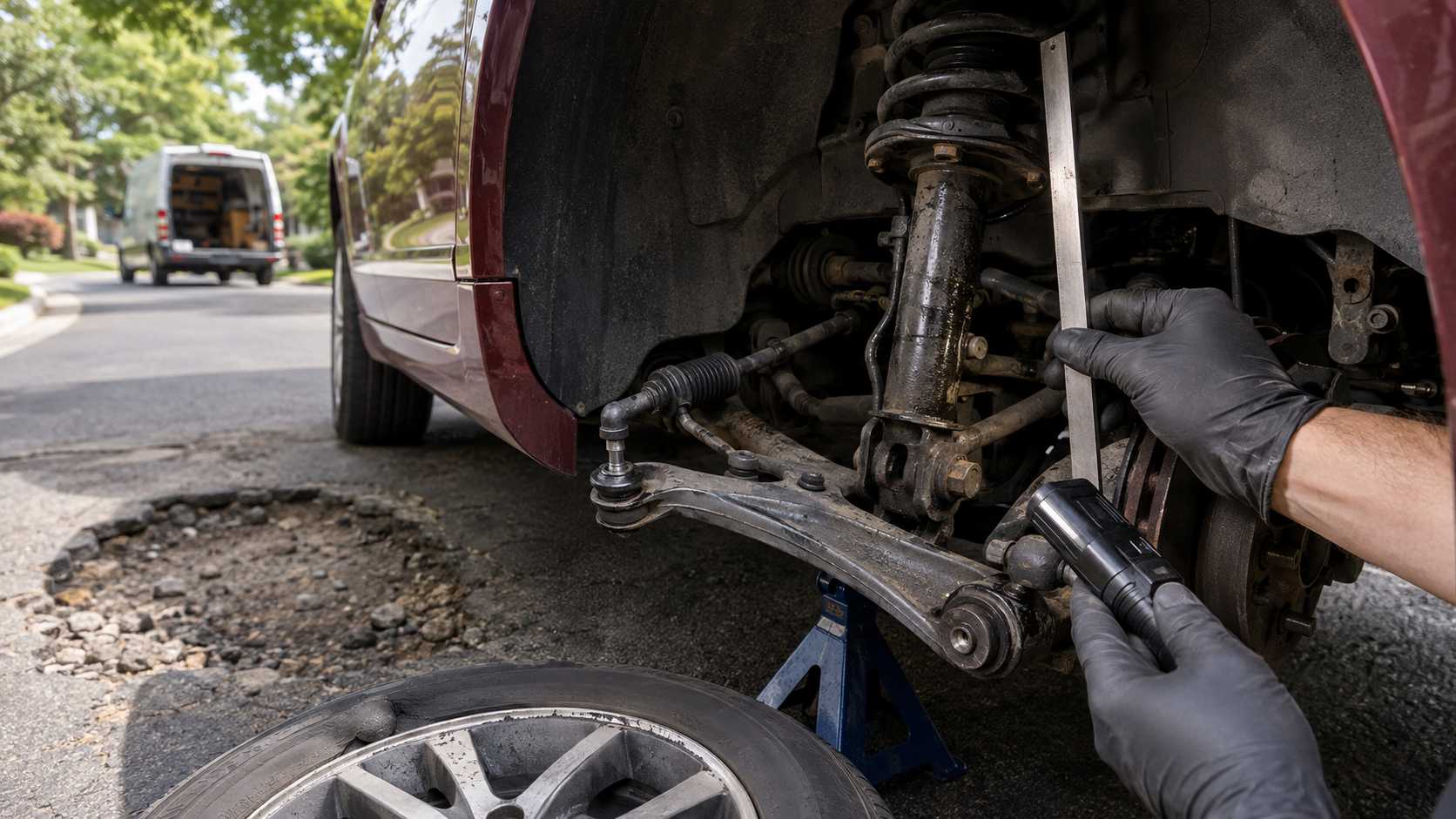
Pothole suspension damage begins with a sharp vertical impact into components designed for gradual loading. Several things can give.
Tyres and wheels
The first point of contact. Look for a sidewall bulge, which indicates the internal cords have been broken by the impact. A bulging tyre can fail without further warning and should be replaced rather than monitored.
Alloy wheels bend or crack at the rim edge. A bent rim causes a vibration that increases steadily with speed and often a slow air leak that seems to have no cause.
Alignment
The most common form of pothole suspension damage, and the easiest to miss because the change is often small.
A hard strike can knock the wheel angles out of specification without bending anything visibly. The car then wears its tyres unevenly, pulls slightly, or sits with the steering wheel off-centre when driving straight.
Control arms and bushings
The impact transmits through the wheel into the control arm. Arms can bend, and bushings can crack or tear away from their housings. A bent arm shifts the wheel’s position permanently, which alignment adjustment cannot always correct.
Tie rod ends and ball joints
Sharp impacts accelerate wear in joints that were already ageing. A pothole rarely destroys a healthy joint outright, but it will finish off one that was already marginal.
Struts and shocks
A severe strike can bend a strut shaft or damage the internal valving. Symptoms include a bouncy ride, a strut that leaks fluid, or a knocking sound over subsequent bumps.
Steering rack
Less common, but a heavy strike can damage internal rack components, producing play or leakage.
What to check straight away after a hard strike
The fastest way to rule out serious pothole suspension damage is a two-minute check at the roadside.
Pull over somewhere safe when you can and do these checks. They take a few minutes.
Look at both tyres on the side that struck the pothole. You are looking for sidewall bulges, cuts, or visible deformation. A bulge means the tyre is compromised.
Look at the wheel rims for flat spots, dents at the edge, or cracks.
Check whether the car sits level.
Then drive gently and note three things: whether the steering wheel is still centred when the car is going straight, whether the car pulls, and whether there is a new vibration.
If everything checks out, you are probably fine, but the next section matters, because pothole suspension damage often reveals itself later.
Symptoms that appear in the following days and weeks
This is where most pothole suspension damage actually surfaces.
The steering wheel sits off-centre. If you have to hold the wheel slightly turned to go straight, the alignment has shifted. This is the single most common delayed symptom.
The car pulls to one side. A steady drift toward one side on a level road points to alignment or, less often, a bent component.
A new vibration at speed. A bent rim or a thrown wheel weight produces vibration that increases with speed.
Uneven tyre wear. Check the inner and outer edges. Wear concentrated on one edge that appeared over a few thousand miles points firmly at alignment.
A new clunk or knock over bumps. This suggests a damaged bushing, joint or strut mount rather than alignment alone.
Slow air loss in one tyre. Often a cracked rim rather than a puncture.
The car feels bouncy or floaty. Points at strut or shock damage.
Any one of these appearing in the weeks after a pothole strike is worth an inspection for pothole suspension damage. The reason is practical as much as mechanical: alignment left uncorrected destroys a tyre within a few thousand miles, and replacing a tyre is a far larger job than correcting the alignment would have been.
When is pothole suspension damage serious enough to stop driving?
Most pothole suspension damage lets you drive to a repair safely. Some does not.
Stop driving and arrange service if you see a visible bulge in a tyre sidewall, if the steering feels loose or vague rather than merely off-centre, if there is a loud clunk or knock accompanied by a change in how the car handles, if the car pulls strongly rather than drifting slightly, or if a wheel is visibly out of position when you look at the car from behind.
Those symptoms suggest structural damage rather than a settings change, and structural damage can worsen suddenly.
How we assess it
Pothole suspension damage assessment is a physical inspection, not a road test alone.
We start with a road test to characterise the symptom, then lift the vehicle so every joint can be checked unloaded. That is the only way play becomes detectable, because a loaded joint hides its own wear.
We inspect control arms for bending, which sometimes requires comparing the struck side against the opposite side directly. We check bushings for cracks and separation, examine struts for leakage and bent shafts, and inspect the wheel and tyre closely for damage that is easy to miss from standing height.
We read tyre wear as evidence of what the geometry has been doing since the impact.
You get photographs of the findings. Our work carries a 12-month/12,000-mile warranty, and we are a CARFAX Top-Rated Service Center, so the repair is recorded against your vehicle’s history.
The alignment sequence that saves rework
One point worth being blunt about.
If a component has bent, aligning the car before replacing it is wasted effort. The alignment adjusts settings; it cannot compensate for a part that has changed shape or a joint that has developed play. The geometry will drift straight back out.
The correct order is always: inspect, replace anything damaged, then align.
If you have had the car aligned after a pothole strike and it has already drifted out again, that is strong evidence of physical pothole suspension damage that the alignment could not address.
Claiming for pothole damage in Virginia
Worth knowing, because most drivers do not.
Virginia has a process for claiming pothole damage against the responsible road authority, and VDOT handles claims for the roads it maintains. Outcomes vary and there are conditions, and notice of the defect is generally a factor, but a claim takes little effort to submit.
What helps is documentation: the date, time and precise location of the strike, photographs of the pothole if you can return safely, and an itemised repair record that specifically identifies the damage as impact-related. Ask for it to be worded that way.
Whether or not you claim, get the inspection. A rejected claim on a repaired car is a better outcome than an unrepaired car.
Frequently Asked Questions
How do I know if a pothole damaged my suspension?
The clearest early signs are a steering wheel that no longer sits centred, a new pull to one side, a vibration at speed, or a new clunk over bumps. Pothole suspension damage is often invisible on inspection from outside, so if the car feels different after a hard strike, have it checked.
Can a pothole cause damage even if nothing seems wrong?
Yes, and this is the common case. Alignment can shift measurably without anything bending visibly, and the consequence shows up weeks later as uneven tyre wear. That is why a post-impact alignment check is worth doing even when the car seems fine.
What does fixing pothole damage involve?
It depends entirely on what was damaged. An alignment is a modest job. A bent control arm plus a wheel and tyre is not. We inspect first and confirm the full scope with you before any work begins.
Should I get an alignment after hitting a pothole?
Get an inspection first. If a component is bent or a bushing has torn, aligning the car before replacing it wastes the alignment because the geometry will not hold. Inspect, repair, then align.
Is it safe to drive with a bent rim?
Not for long. A bent rim causes vibration, uneven tyre wear, and often a slow leak, and a cracked rim can fail. Have it assessed promptly rather than driving on it through the season.
Book a suspension inspection after a pothole strike and we will check every joint and the alignment before recommending anything.
Keep Reading
How to Make Your Brakes Last Longer
Practical ways Northern Virginia drivers can make brake pads and rotors last longer, and when it is time to book mobile brake…
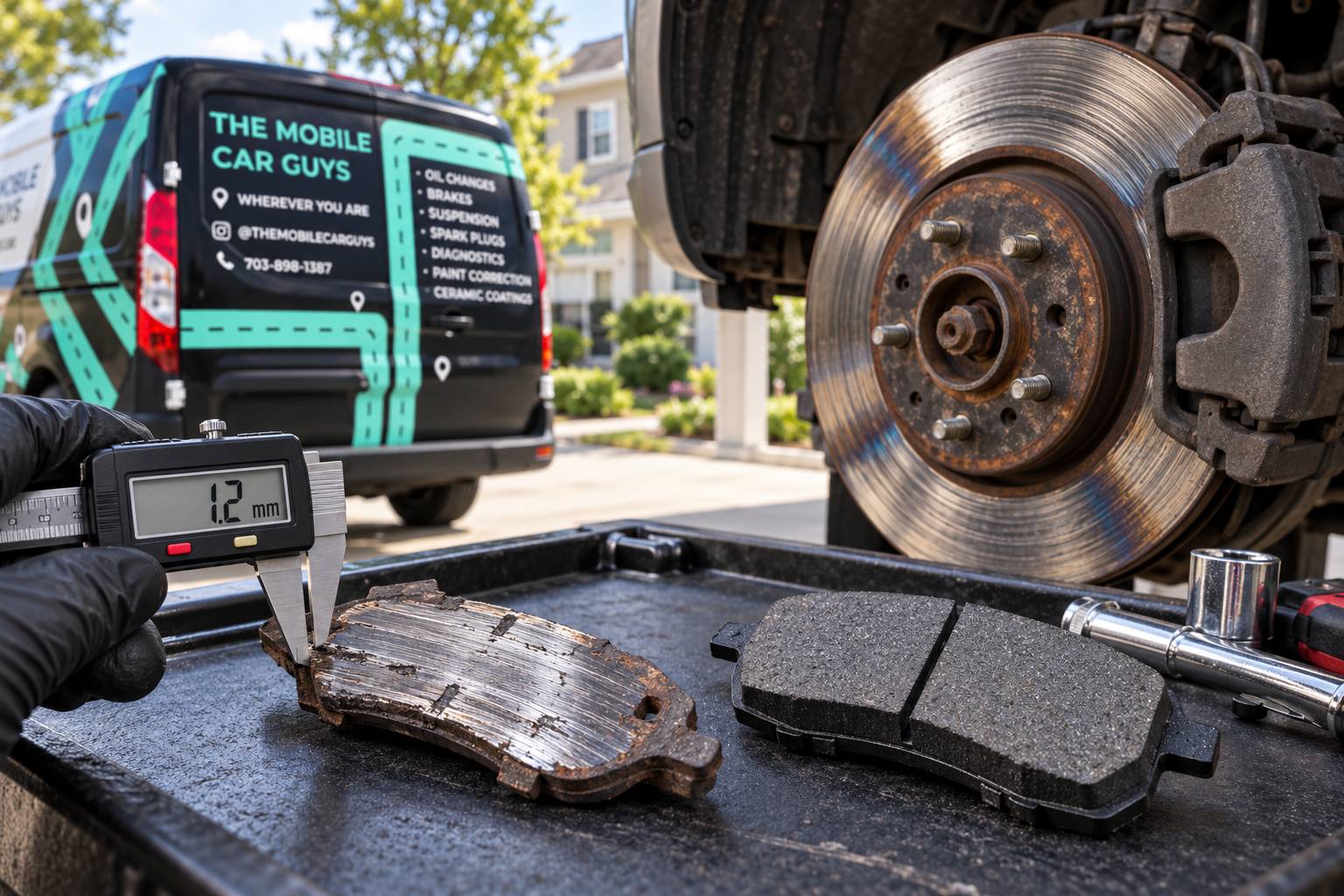
Metal-on-Metal Brakes: What Happens If You Wait Too Long
What metal-on-metal brakes mean, the damage caused by waiting, and when pads and rotors should be replaced at your location.
Brake Noise Decoder: Squeal, Grind, Clunk, or Squeak?
What a squeal, grind, clunk, or squeak means when you brake, and which brake noises need repair now.