
Grinding Noise When Braking: When You Need Professional Brake Repair
We are an auto repair shop serving Northern Virginia, and of every brake symptom drivers describe to us, a grinding noise when braking is the one we least like to hear on the phone.
Squealing is a warning. Grinding is a consequence. By the time you hear metal scraping metal every time you slow down, the part designed to wear out has already worn out, and something that was not designed to wear is now being destroyed.
This article explains exactly what is making that sound, why it gets worse quickly, and how to judge whether you can finish your week or need to stop driving today.
What a grinding noise when braking actually is
A brake pad is friction material bonded to a steel backing plate. The friction material is the consumable part. It is designed to wear away gradually against the rotor over tens of thousands of miles.
When that material is completely gone, the steel backing plate makes direct contact with the cast-iron rotor face. That is the grinding noise when braking that you are hearing. Two pieces of metal are grinding against each other under several hundred pounds of hydraulic clamping force.
It is a harsh, low, gravelly sound rather than a high squeal. It usually gets louder the harder you press. You may feel it through the pedal as a rough vibration. Sometimes you can hear it faintly even when you are not braking, because the pad is dragging slightly. The important point is this: nothing about that sound is normal, and nothing about it will resolve on its own.
Why grinding brakes get worse fast
A worn pad wears slowly. A steel backing plate cutting into a rotor removes material fast.
Every single stop you make gouges a groove into the rotor face. Within days of driving, a rotor that could have been reused becomes scrap. Within a couple of weeks, in some cases, the backing plate can cut deep enough to compromise the rotor’s structure entirely.
Meanwhile, your stopping distance is increasing. Steel against cast iron generates far less friction than proper pad material does, so the car takes longer to stop even though you are pressing just as hard. The system also runs hotter, which can boil brake fluid and give you a soft pedal on top of everything else.
This is why a grinding noise when braking is treated differently from every other brake symptom. It is not a maintenance reminder. It is active damage occurring on every stop.
Other causes worth ruling out
Not every grinding noise when braking is a fully worn pad. A proper inspection rules out the alternatives before anything is replaced.
A stone or debris trapped in the caliper
Small stones can lodge between the rotor and the dust shield, or inside the caliper bracket. This produces a persistent scraping that changes pitch with wheel speed rather than with brake pressure. It is the one cause on this list that can be genuinely trivial to fix, but it still needs looking at, because a trapped stone can score a rotor badly.
Surface rust after the car has sat
A vehicle parked outside through wet Northern Virginia weather develops a light rust film on the rotors overnight. The first few stops of the day scrape it off with a gritty sound that then disappears completely. That is normal. If the sound persists past the first few stops, it is not rust.
A seized caliper
A caliper that will not release keeps the pad clamped against the rotor constantly. That corner overheats, the pad wears out prematurely, and you get a grinding noise when braking from one wheel only, usually alongside a burning smell and the car pulling to that side.
A failed wheel bearing
A worn bearing produces a grinding or humming that is usually present while driving and changes when you steer, rather than appearing only when you brake. It is easy to confuse with brake noise, and it is a genuine safety issue in its own right.
Should you keep driving?
Here is the honest answer, and it is not the cautious one.
If the grinding is intermittent, mild, and clearly limited to the first few stops after the car has been parked outside overnight, that is probably rust and you are fine.
If the grinding happens on every stop, at any speed, get the car looked at within days rather than weeks. You are actively destroying rotors and your stopping distance is compromised.
Stop driving and arrange service the same day if the grinding is accompanied by any of the following: a brake pedal that sinks toward the floor, a burning smell after driving, a car that pulls strongly under braking, or a noticeable increase in how much room you need to stop. That combination points to a failure that goes beyond worn pads.
There is no scenario where continuing to drive with grinding brakes for another month is the economical choice. The repair only gets larger.
What the repair usually involves
Once pads have worn to the backing plate, the rotors on that axle almost always need replacing too. Their surface has been cut by steel, and a scored rotor cannot provide the even contact new pads require. Machining is rarely viable, because the rotor has usually lost too much thickness already.
So the typical repair after a grinding noise when braking is a full pad and rotor replacement on the affected axle. Where the caliper has seized or the hardware has corroded, those parts are addressed at the same time.
If you caught it very early, with some grinding but no deep scoring yet, pads alone occasionally remain an option. That decision comes from measuring the rotor, not from guessing.
Every brake repair we complete is backed by a 12-month/12,000-mile warranty on our work, and we are a CARFAX Top-Rated Service Center, so the service is recorded against your vehicle’s history.
Why this happens more often in Northern Virginia
Brake pads here wear faster than the national average, and the cause is straightforward: this region does an enormous amount of low-speed, high-frequency braking.
A commute that crawls along I-66, the Beltway, or the Fairfax County Parkway involves hundreds more brake applications per week than a rural or highway-dominant drive. Each application generates heat. Heat consumes friction material.
The result is that drivers here often hit the grinding stage before the mileage figure in their owner’s manual suggests they should. If your car is approaching the interval and you commute in traffic, have the pads measured rather than trusting the number.
Winter road treatment adds a second factor. Salt and brine accelerate corrosion on caliper slide pins and hardware, and a partially seized caliper wears one pad down far faster than the other, producing grinding from a single wheel while the rest of the brakes look fine.
What we check on arrival
When we come out to a grinding noise when braking, the inspection follows the same order every time, because guessing wastes your time.
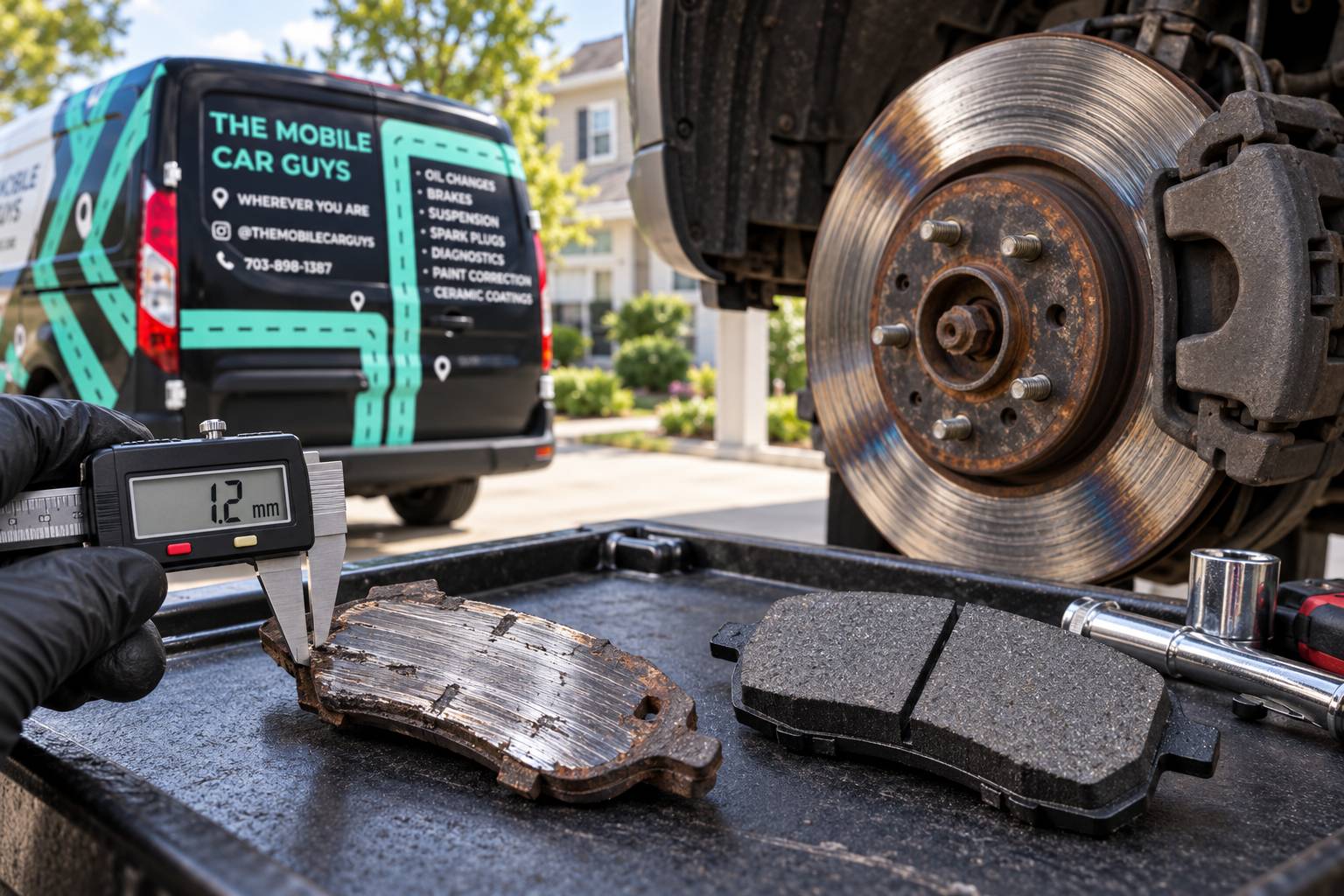
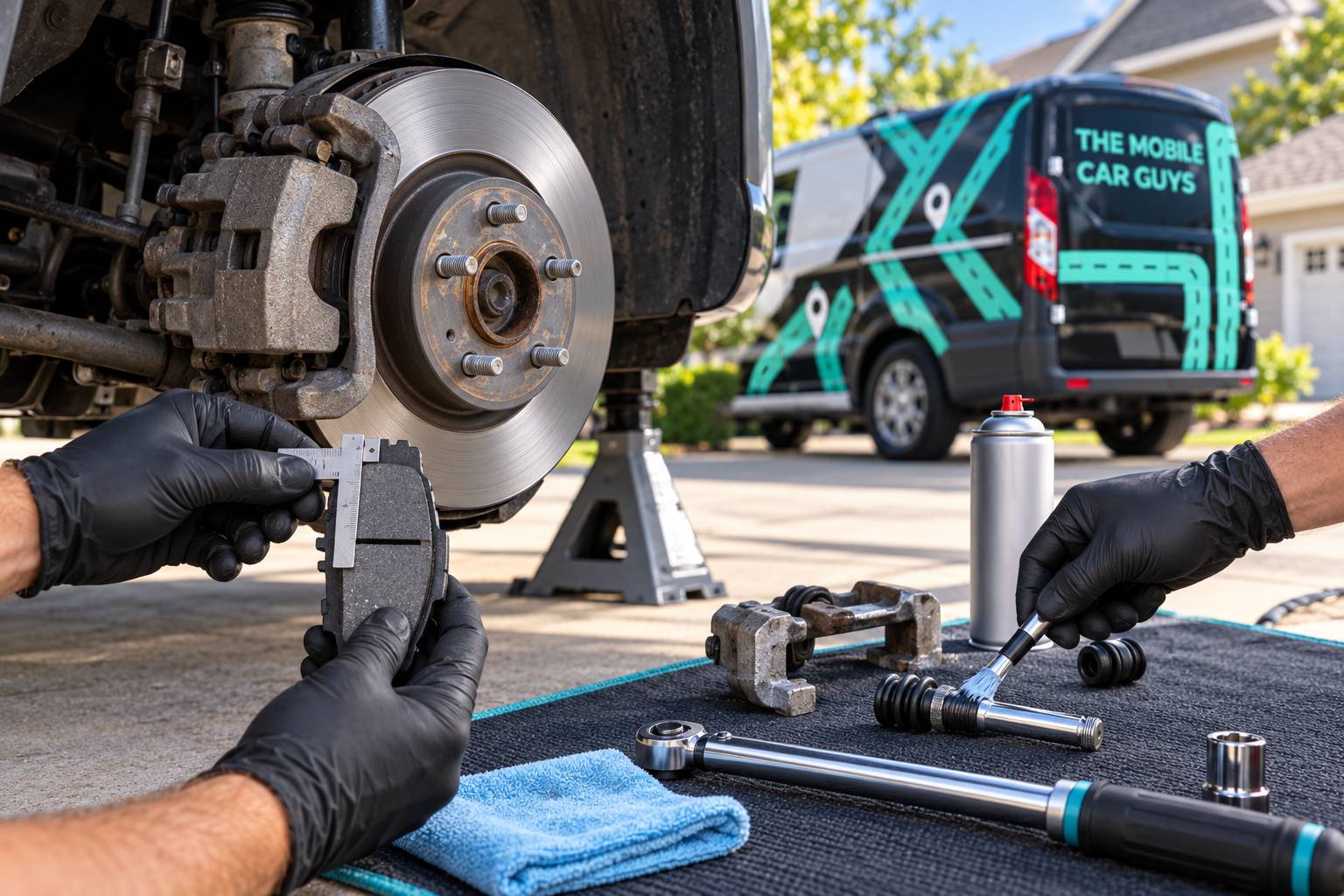
We pull each wheel and measure remaining pad thickness on both the inner and outer pad. A large difference between the two on the same caliper is the fingerprint of a seized slide pin. We measure rotor thickness against the minimum specification cast into the hub, and run a finger across the face to assess scoring depth.
We check the caliper piston retracts smoothly and that the slide pins move freely. We inspect the flexible brake hose for swelling or cracking, because a collapsed hose can hold pressure on a caliper and mimic a seizure exactly. Finally we check fluid condition, since a system that has been running hot has usually cooked its fluid too.
You get photographs of all of it. If we say a rotor is finished, you see the groove.
How to avoid getting here again
The squeal comes first. Most brake pads have a small metal wear indicator that contacts the rotor when the pad gets thin, producing a high-pitched squeal specifically to warn you. That sound typically arrives with a few thousand miles of pad life remaining.
If you act on the squeal, you replace pads. If you ignore it until you hear a grinding noise when braking, you replace pads and rotors, and sometimes calipers. The difference in scope between those two jobs is substantial, and the only variable is how quickly you responded to the first sound.
Have your brakes measured at every oil change. It takes a few minutes and it removes the guesswork completely.
It is also worth knowing that a grinding noise when braking rarely appears without warning. Drivers frequently tell us afterwards that there had been a squeal for a month, or a faint vibration, or that the car had started needing a little more room to stop. Those were the easy moments to act.
Frequently Asked Questions
How long can I drive with grinding brakes?
Days, not weeks, and only if the grinding is the sole symptom. Every stop deepens the damage to the rotor and lengthens your stopping distance. If the pedal also feels soft or the car pulls, stop driving and arrange service.
Does a grinding noise when braking always mean new rotors?
Usually, but not always. If the backing plate has scored the rotor face, that surface cannot support new pads properly and the rotor is replaced. If you caught it early enough that the scoring is superficial and the rotor measures within specification, pads alone may be sufficient. We measure before recommending.
Why do my brakes grind only in the morning?
That is almost certainly surface rust that formed overnight on rotors exposed to damp air. It scrapes off within the first few stops and disappears. If the noise persists after that, it is not rust and needs inspecting.
Is a grinding noise when braking covered by warranty work?
If we perform the repair, the work carries a 12-month/12,000-mile warranty. If your brakes were recently serviced elsewhere and are already grinding, that is worth investigating. Premature wear on one corner usually points to a hardware or caliper problem that was missed rather than to the pads themselves.
Can grinding be something other than brakes?
Yes. A failing wheel bearing produces a similar sound, but it is generally present while driving and changes when you turn, rather than appearing only under braking. Both warrant prompt attention.
Book a brake inspection and we will measure exactly what is worn before recommending anything.
Keep Reading
Car Vibrates When Accelerating: CV Axle or Something Else?
We're an auto repair shop serving Northern Virginia, and loose, vague steering is far more than an annoyance
Pothole Suspension Damage: Signs Northern Virginia Drivers Should Check
We're an auto repair shop serving Northern Virginia, and loose, vague steering is far more than an annoyance
Why Do My Brakes Squeak Only in the Morning?
We're an auto repair shop serving Northern Virginia, and loose, vague steering is far more than an annoyance