QUICK ANSWER
The Virginia safety inspection checks ball joints, tie rod ends, control arm bushings, wheel bearings, steering play, power steering leaks, coil springs and shock absorbers. If your car is rejected for any of these, you have 15 days to repair it and return for reinspection. Most suspension and steering rejections can be repaired in a single visit at your home or office.
A rejection slip from your annual inspection is frustrating, especially when the car felt fine on the drive in. Suspension and steering parts wear slowly, so drivers often do not notice a loose ball joint or a leaking shock until an inspector puts the car on a lift. If you live or work in Fairfax and your car just failed, this guide explains what was checked, why it was rejected, and how to get it fixed well inside the 15-day window.
What the Virginia Safety Inspection Checks on Suspension and Steering
Virginia State Police set the inspection standards, and every licensed station follows the same list. For the front end, steering and suspension, the inspector looks at:
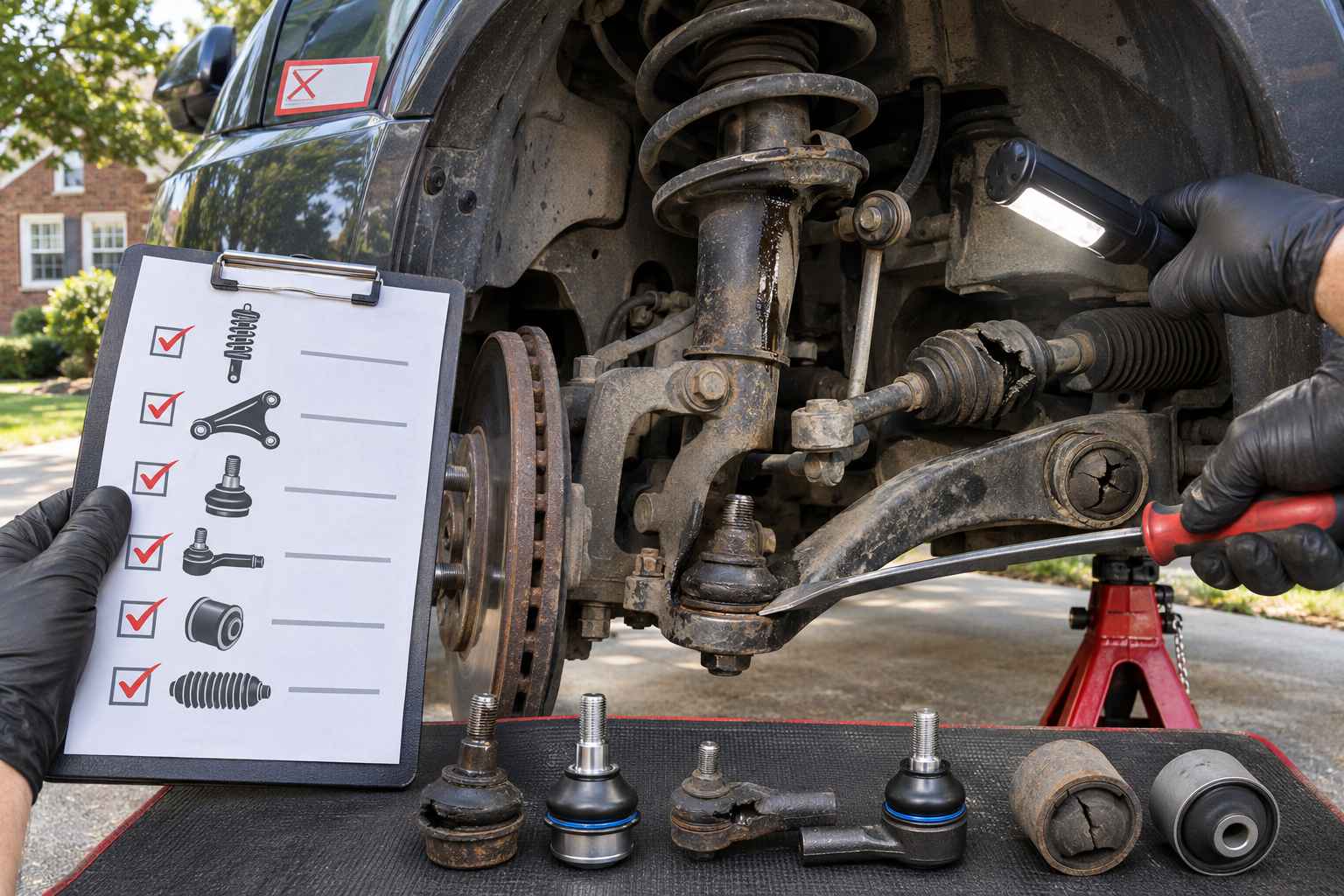
- Ball joints: excessive up-and-down or side-to-side movement.
- Tie rod ends: play in the joints that connect the steering rack to the wheels.
- Bushings: worn or torn rubber in control arms and other mounting points.
- Wheel bearings: looseness or roughness when the wheel is rocked.
- Steering play: too much free movement in the steering wheel before the wheels respond.
- Power steering system: fluid leaks from the pump, hoses or rack.
- Wheel alignment: obvious misalignment between the wheels.
- Coil springs and leaf springs: broken coils or broken spring leaves.
- Shock absorbers: leaking, broken or missing shocks.
Because these items are on the official list, the inspector has no discretion. If a part is outside the limit, the car is rejected.
The Most Common Rejections We See
Worn ball joints
Ball joints carry the weight of the car and let the front wheels steer and move up and down. Once the joint wears, it develops play the inspector can feel with a pry bar. You may have noticed a clunk over bumps or vague steering. Read more about the warning signs in our guide to bad ball joints.
Loose tie rod ends
Tie rods translate steering wheel movement into wheel movement. Worn inner or outer tie rods create free play, uneven tire wear and a wandering feel at highway speed. This is one of the most frequent steering rejections.
Leaking shocks or struts
A shock that is wet with oil has lost its damping fluid. Inspectors reject shocks that are leaking, broken or disconnected. A leaking strut usually means the car has also been bouncing more after bumps and taking longer to settle.
Torn bushings and broken springs
Rubber control arm bushings crack with age and heat. Coil springs can snap near the end coil, often after a hard pothole hit or years of road salt. Both are easy for an inspector to see and both lead to rejection.
Your 15-Day Window: What It Means
When a car is rejected, Virginia gives you 15 days to correct the problem and return for reinspection. Here is how to use that time well:
| Step | What to do | When |
|---|
| 1 | Keep the rejection paperwork; it lists the exact items that failed. | Same day |
| 2 | Book a repair and share the list with the technician. | Days 1–3 |
| 3 | Have the parts replaced and the car road-tested. | Days 3–7 |
| 4 | Ask whether an alignment is needed after steering work. | Before reinspection |
| 5 | Return to the inspection station for reinspection. | Before day 15 |
Leaving it to the last few days creates stress if a part has to be ordered for your vehicle. Booking early gives you room.
Can I Keep Driving After a Rejection?
A rejection does not take the car off the road immediately, but the parts that failed are safety items. A badly worn ball joint can separate, which can cause the wheel to fold under the car. A loose tie rod can make steering unpredictable. If the inspector marked a part as severely worn, limit driving until it is replaced. Routes with higher speeds and heavier traffic, such as Route 50, Interstate 66 and the Fairfax County Parkway, put extra load on worn steering parts.
How We Repair Inspection Failures at Your Location
Our technicians come to your driveway, office lot or parking garage with the parts and tools for the job. For inspection-related repairs, the process is simple:
- Review the rejection list. We confirm the exact parts that failed and check the related components, so you do not fail again for a neighboring part.
- Quote before work starts. You get a clear price for the parts and labor for your specific vehicle.
- Replace with quality parts. We install parts that meet or exceed the original specification.
- Test and document. We road-test the car and give you a record of the work to take to reinspection.
Common repairs include ball joint replacement, tie rod replacement, shock and strut replacement and control arm replacement.
Drivers across Fairfax book this service because they do not lose half a day sitting in a waiting room. We also serve nearby Oakton, Vienna and Falls Church, so if you work in one city and live in another, we can meet you wherever the car is parked.
How to Avoid a Rejection Next Year
Most suspension rejections are predictable. A few habits reduce the chance of a surprise:
- Have the suspension checked when you notice clunks, pulling or uneven tire wear, not just at inspection time.
- Ask for a suspension inspection before winter, when pothole damage is most common.
- Replace shocks and struts in pairs so both sides of the axle wear evenly.
- Book a pre-purchase inspection before buying a used car, so you know what may fail at the next inspection.
Key Takeaways
- Virginia’s safety inspection checks ball joints, tie rod ends, bushings, wheel bearings, steering play, power steering leaks, alignment, springs and shocks.
- A rejected car must be repaired and reinspected within 15 days.
- Book the repair in the first few days so there is time for parts and an alignment if needed.
- Checking neighboring parts during the repair helps you avoid failing again for a different item.
- Most suspension and steering rejections can be fixed in one visit at your home or office.
Frequently Asked Questions
Book Your Inspection Repair
Do not let a rejection run down the clock. Share your rejection list when you book, and we will confirm the parts, give you a price and schedule the repair at your location so you can return for reinspection with time to spare.