Clunking Noise Over Bumps? Ball Joints, Tie Rods, or Control Arms
We are an auto repair shop serving Northern Virginia, and a clunking noise when driving over bumps is the single most common suspension complaint we are called out for.
It is also one of the most misdiagnosed. The sound travels through the car’s structure, which makes it genuinely hard to locate by ear, and the components that produce it range from a minor one to one that carries a real safety consequence.
This article walks through how to narrow it down before anyone recommends anything.
First, describe the noise precisely
The details you might dismiss as irrelevant are the ones that identify the component.
When does it happen? A clunking noise when driving over bumps only, versus one that also appears when turning, versus one that appears when braking, points at three different parts of the car.
Is it one clunk or several? A single sharp knock as the wheel drops into a dip suggests something with play in it. A rattle or repeated knocking over a rough surface suggests a link or a loose mount.
Front or rear? Left or right? Harder than it sounds, but a rough sense helps.
Does anything else feel different? Vague steering, a shake under braking, uneven tyre wear or an alignment that will not hold all narrow the field considerably.
The likely causes, roughly in order
Sway bar links
Start here, because this is the most common cause of a clunking noise when driving over bumps and the simplest to fix.
Sway bar links connect the anti-roll bar to the suspension on each side. They are small, they take constant load, and their ball sockets wear out. Once there is play in the socket, every small bump produces a knock.
If your clunking noise when driving over bumps is light and rattly over small or repeated surfaces such as expansion joints, rough tarmac and speed humps, rather than a heavy thud, this is the likely source. The car otherwise drives normally, with no steering vagueness.
This part is frequently misdiagnosed as something far more involved. Insist on a joint-by-joint check before accepting a recommendation for control arms.
Control arm bushings
Control arms attach to the car’s structure through rubber bushings that isolate vibration and allow the arm to pivot. That rubber perishes with age, heat and road salt, and eventually cracks or separates from its housing.
A worn bushing produces a deeper, heavier clunk than a sway bar link, more of a thud, most noticeable over sharp-edged bumps, potholes and driveway entrances. It often comes with steering that feels imprecise and an alignment that drifts out of specification within a few months.
On many vehicles the bushing is not separately available and the complete arm is replaced.
Ball joints
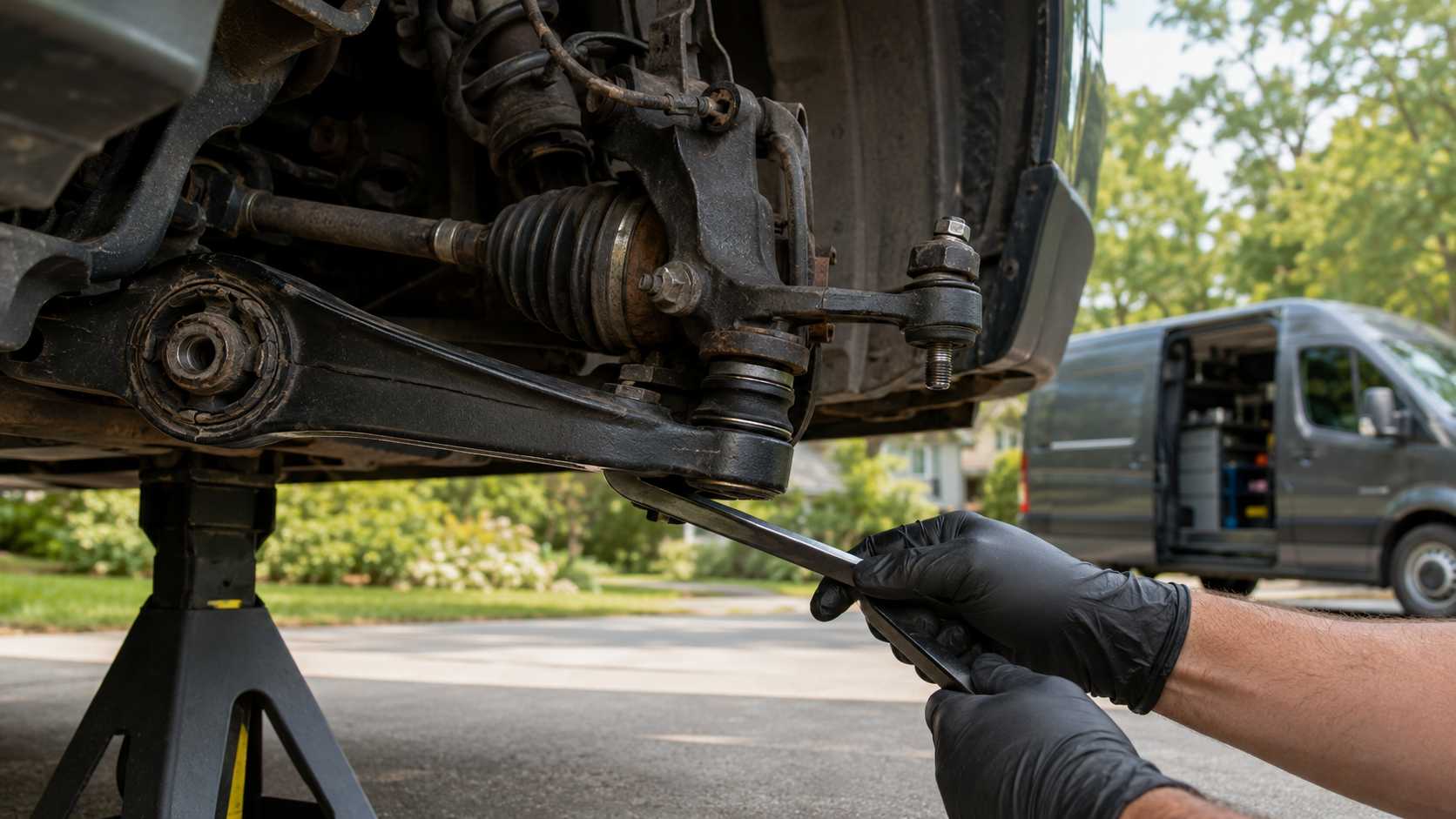
Ball joints let the front wheel steer and move vertically at once. They wear from the inside, and once there is play, the joint knocks as the load reverses over a bump.
A worn ball joint typically produces a clunking noise when driving over bumps that gets worse when turning at low speed, alongside a wandering feel at speed and uneven tyre wear on one edge.
This is the component we treat with the most urgency on the list. A severely worn ball joint can separate, and if it does, the wheel folds under the car. It is uncommon, but the outcome is severe enough that we do not recommend leaving a joint with significant play.
Tie rod ends
Tie rods connect the steering rack to the wheels. Wear produces play, and play produces a knock, though the sound is usually lighter than a ball joint and much more strongly associated with steering input than with bumps alone.
The clearer symptoms of tie rod wear are steering feel rather than noise: a wheel that needs constant small corrections, vagueness on centre, and often a shake under braking. Any tie rod replacement requires an alignment afterwards.
Strut mounts
The top of a strut attaches to the body through a mount that usually contains a bearing. When it fails, you get a clunking noise when driving over bumps and often a distinct creak or groan when turning the steering at low speed, such as in a car park.
Worn shocks or struts themselves
A failed strut can allow the suspension to reach the end of its travel and knock. Usually accompanied by a floating ride, excessive nose-dive under braking, and cupped tyre wear.
Things that are not suspension at all
Worth ruling out first. Loose exhaust hangers produce a knock over bumps that is easy to mistake for suspension. So does a loose heat shield, or an item rolling around in the boot. We check the simple explanations first, because occasionally a clunking noise when driving over bumps turns out to be nothing at all.
Why you cannot diagnose a clunking noise when driving over bumps from the driver's seat
Here is the part that matters most, and it explains why “just replace the control arms” is such a common and avoidable mistake.
Suspension components are under load when the car’s weight is on the wheels. Under load, a worn joint is compressed and its play is hidden. It knocks over bumps because the load momentarily reverses. Sitting still, it feels tight.
To find play, the wheel has to come off the ground so the joint is unloaded. Then each joint is checked by hand and with a pry bar, one at a time. That is the only reliable method, and it is why a proper diagnosis involves lifting the vehicle rather than listening from the kerb.
Anyone recommending suspension work purely from a description of the noise is guessing.
How we work through it
We road test first, over the kind of surface that reproduces the noise. Conditions matter: a clunk that appears only when turning into a driveway tells us something different from one that appears on the motorway expansion joints.
Then the wheels come off the ground and every joint is checked individually: ball joints, tie rod ends, control arm bushings, sway bar links, strut mounts and wheel bearings. We inspect shocks for leakage and check the mounts.
We read the tyres, because tyre wear is physical evidence. Cupping points to shocks. Inner-edge wear points to alignment or worn inner components. Feathering points to toe angle.
You get photographs of the play we found. When we recommend a repair for a clunking noise when driving over bumps, you should be able to see the movement in the joint rather than take the diagnosis on faith.
Our work carries a 12-month/12,000-mile warranty, and we are a CARFAX Top-Rated Service Center, so what was replaced is recorded against your vehicle’s history.
Why this is so common in Northern Virginia
Two local factors, and they compound.
Potholes are the obvious one. Freeze-thaw cycling opens them across the region every winter, and a single hard strike can crack a bushing, bend a control arm or damage a wheel. Route 7, the Fairfax County Parkway and the older residential streets around Vienna and McLean are consistently rough by late winter. Plenty of the cars we see developed a clunking noise when driving over bumps within days of a specific pothole the owner still remembers hitting.
Road salt is the less obvious one. Brine and salt accelerate corrosion on bushing housings, fasteners and joint boots. Once a rubber boot splits, the grease escapes, water and grit get in, and the joint wears far faster than it otherwise would. Components that might last a decade elsewhere fail sooner here.
How urgent is it?
A clunking noise when driving over bumps can mean anything from a minor component to one worth acting on today. Honest answer: it depends entirely on which component, which is the whole reason to diagnose rather than guess.
A worn sway bar link is a comfort and noise issue. It is safe to drive on for a while, and it should be fixed because it is simple rather than because it is dangerous.
A worn control arm bushing affects steering precision and will not hold an alignment. Fix it within weeks, and sooner if it is causing uneven tyre wear, since tyres are the real consequence.
A worn ball joint or tie rod end should be dealt with promptly. Both have failure modes that involve losing control of the wheel.
If the clunking comes with vague steering, a pull, uneven tyre wear, or any sense that the car does not go quite where you point it, treat it as urgent rather than routine.
Frequently Asked Questions
Is a clunking noise when driving over bumps dangerous?
It depends on the source. A sway bar link is a nuisance. A worn ball joint is a safety issue. Since the noises are similar and the consequences are not, the sensible response is an inspection rather than a judgement call from the driver’s seat.
Why does my car clunk over bumps but drive fine otherwise?
That pattern usually points to a sway bar link or a strut mount, components with play that only shows when the suspension moves through its travel. If steering feel is genuinely unaffected, the more serious joints are less likely, though they are not ruled out.
Can I just replace the sway bar links and see if it fixes it?
It is a reasonable gamble in that the parts are simple, but it is still a gamble. A proper joint-by-joint check takes less effort than replacing the wrong component twice, and it also tells you whether anything more serious is developing.
Will new bushings fix my alignment problem?
Often, yes. If an alignment will not hold, a worn bushing or joint letting the geometry move under load is the usual explanation. Replace the worn part first, then align. Doing it the other way round wastes the alignment.
Does a clunk mean the whole suspension needs replacing?
Rarely. Most cases come down to one or two components. Full front-end replacement is sometimes recommended where a joint-by-joint inspection would have identified two parts. Ask to see the play that justifies each item.
Book a suspension inspection and we will check every joint individually before recommending anything.
Keep Reading
How to Make Your Brakes Last Longer
Practical ways Northern Virginia drivers can make brake pads and rotors last longer, and when it is time to book mobile brake…
Metal-on-Metal Brakes: What Happens If You Wait Too Long
What metal-on-metal brakes mean, the damage caused by waiting, and when pads and rotors should be replaced at your location.
Brake Noise Decoder: Squeal, Grind, Clunk, or Squeak?
What a squeal, grind, clunk, or squeak means when you brake, and which brake noises need repair now.