
Car Vibrates When Accelerating: CV Axle or Something Else?
We are an auto repair shop serving Northern Virginia, and vibration complaints are among the hardest to diagnose remotely, because a car vibrates when accelerating for reasons ranging from a simple engine mount to a failing axle.
The good news is that vibration is unusually informative if you note exactly when it happens. The conditions that trigger it narrow the field faster than any other symptom description.
The question that narrows it down fastest
When a car vibrates when accelerating, one test eliminates most of the possibilities in under a minute.
Before anything else, establish this: does the vibration change when you lift off the accelerator?
Get up to a speed where you feel it. Keep your foot in it and note the vibration. Then lift off and coast at the same speed without braking.
If the vibration disappears or reduces markedly when you coast, the problem is load-dependent. That means it is in the drivetrain, most likely an inner CV joint, possibly a driveshaft or an engine or transmission mount.
If the vibration is unchanged whether you accelerate or coast, it is speed-dependent rather than load-dependent. That points to wheel balance, a bent rim, a damaged tyre, or a wheel bearing.
If it appears only under braking, it is a brake rotor problem, not a drivetrain one.
This single test does more diagnostic work than any amount of describing the sound. When a car vibrates when accelerating and smooths out on a coast, look at the CV axles first.
Why a bad CV axle causes vibration under load
Most cars driven in this region are front-wheel drive or all-wheel drive, and both use CV axles to transmit power from the transmission to the wheels.
Each axle has two constant-velocity joints. The outer joint, near the wheel, handles the large angle changes of steering. The inner joint, near the transmission, handles the up-and-down movement of the suspension and allows the axle to change length slightly as the wheel travels.
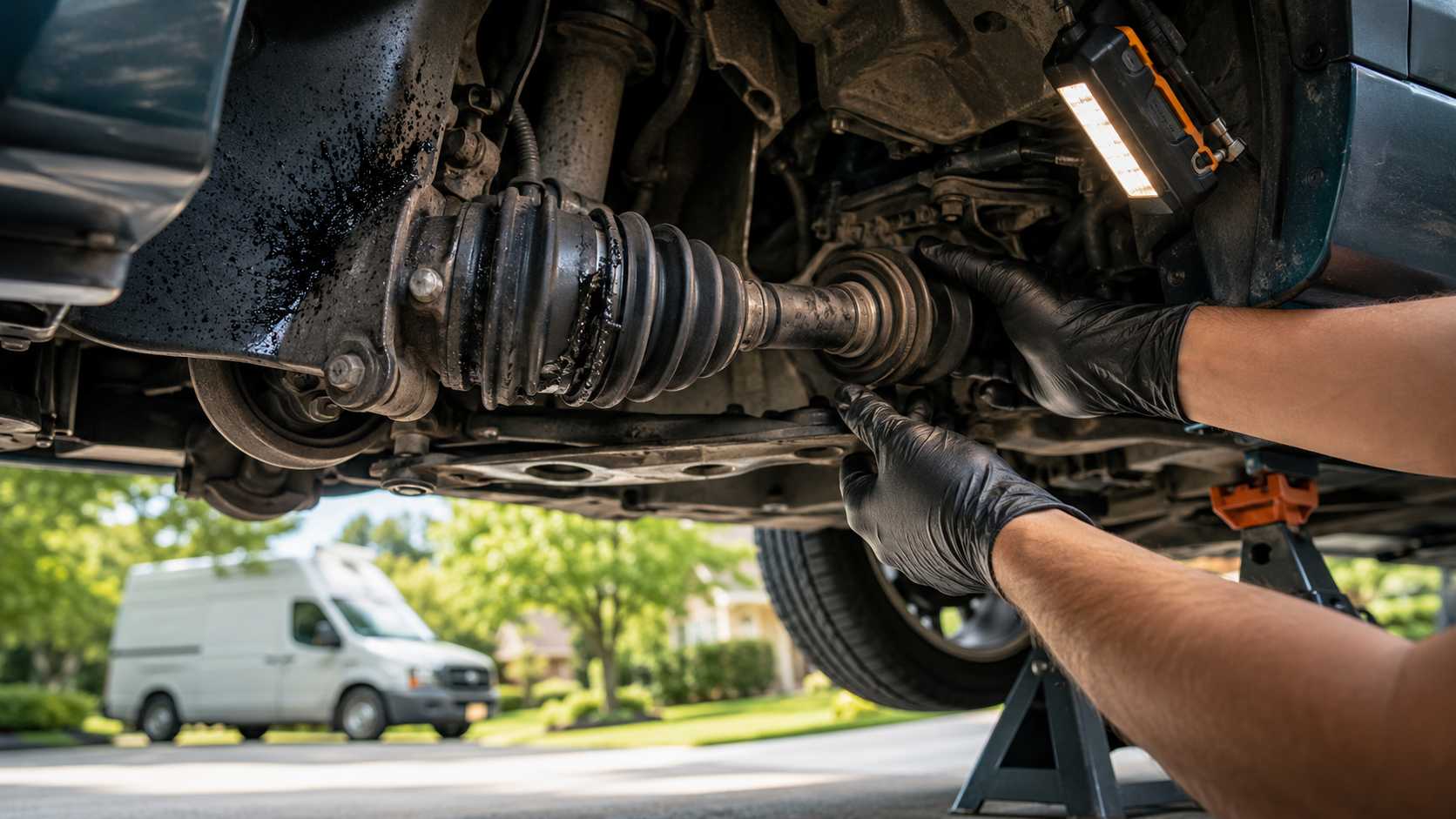
Both joints are packed with grease and sealed inside a rubber boot. That boot is the weak point. When it splits, whether from age, heat or road debris, the grease is flung out and grit gets in. The joint then wears rapidly.
Here is why that produces vibration specifically under acceleration. Under power, the joint is loaded and torque is being transmitted through worn internal components that no longer fit together precisely. Coasting removes that torque, the joint unloads, and the vibration subsides.
The two joints also fail with different symptoms, which is useful.
A worn inner joint produces vibration under acceleration, often felt through the floor or the seat. This is the classic cause when a car vibrates when accelerating.
A worn outer joint produces a rhythmic clicking or popping when turning at low speed, particularly on full lock. Tight turns in a car park are the reliable test.
A single axle can have one worn joint and one healthy one, so both symptoms may not appear together.
The other reasons a car vibrates when accelerating
Engine or transmission mounts
Mounts are rubber blocks that hold the powertrain and absorb its vibration. When the rubber perishes or splits, that vibration transfers into the body.
The signature is a vibration or shudder felt most strongly at low speed under hard acceleration, at idle, or when shifting into gear. Unlike a CV axle, it usually does not scale with road speed. A clunk when changing between drive and reverse is a strong supporting clue.
Wheel balance
An out-of-balance wheel produces vibration in a specific speed band, typically 50 to 70 mph, and it is present whether you are accelerating or coasting. That coasting test rules it in or out at once.
A bent wheel or damaged tyre
Common in this region after pothole season. A bent rim produces vibration that increases steadily with speed. A tyre with a separated belt produces a vibration or wobble that can be felt at lower speeds and is often visible as an irregularity in the tread.
Wheel bearings
A failing bearing usually produces a hum or growl rather than a vibration, and the defining characteristic is that the sound changes when you steer left and right at speed, because steering shifts load between the bearings. It is generally present whether accelerating or coasting.
This is the comparison people most often ask about: CV axle versus wheel bearing. The distinction is straightforward. A CV axle problem is load-dependent and changes when you lift off. A wheel bearing problem is speed-dependent and changes when you steer.
Driveshaft issues on all-wheel-drive vehicles
An unbalanced driveshaft or a worn centre support bearing produces vibration that increases with speed and is often felt through the centre of the car rather than the steering wheel.
How we diagnose it
When a customer tells us their car vibrates when accelerating, the diagnosis follows a fixed order. We road test first, and specifically we replicate the accelerate-versus-coast comparison, because whether the vibration is load-dependent determines everything that follows.
Then the vehicle is lifted. CV boots are inspected on all axles. A split boot with grease sprayed around the inside of the wheel arch is often visible at a glance and is strong evidence. Joints are checked for play by hand.
Wheel bearings are checked for roughness and play with the wheel off the ground. Wheels and tyres are inspected for damage, separation and irregular wear. Engine and transmission mounts are inspected for cracking and separation, and checked for excessive movement under load.
You get photographs of what we found. When we say the reason your car vibrates when accelerating is a torn inner CV boot, you should be able to see the grease.
Our work carries a 12-month/12,000-mile warranty, and we are a CARFAX Top-Rated Service Center, so the repair is recorded against your vehicle’s history.
What the repair involves
Once we have established why the car vibrates when accelerating, the repair depends on which component is at fault. For a worn CV axle, the complete axle assembly is usually replaced rather than the individual joint. This is not upselling. On most vehicles, replacing the complete axle takes little more work than rebuilding a single joint, and it renews both joints and both boots at once.
If a boot has split but the joint has not yet worn, boot replacement alone is sometimes viable. That window is narrow, though. Once grit has been in the joint, the damage is done, and fitting a new boot over a worn joint means doing the job twice. We will tell you honestly which situation you are in.
For mounts, the failed mount is replaced. For balance, wheels are rebalanced. For a bent rim or a separated tyre, that wheel or tyre is replaced.
Why boots split more often here
Two local factors shorten CV boot life in Northern Virginia.
Road salt and brine are the first. Winter treatment across Fairfax and Loudoun counties degrades rubber over repeated seasons, and a boot that has been embrittled by salt exposure cracks far sooner than one in a mild climate.
Road debris is the second. Pothole season leaves broken asphalt across the region every spring, and thrown fragments strike the underside of the car directly where the boots sit.
The practical advice is simple: have your CV boots inspected at every oil change. A split boot caught before grease loss becomes significant is a small job. The same boot found six months later has usually taken the joint with it, and by then the car vibrates when accelerating and the whole axle needs replacing.
How urgent is it?
If your car vibrates when accelerating because of a worn CV joint, you are not in urgent danger. A CV axle that has started to vibrate is worn but not usually at the point of imminent failure. You have weeks rather than days, and continuing to drive is generally safe.
That said, the failure mode is worth knowing. A severely worn CV joint can eventually separate, and if the outer joint separates, that wheel loses drive entirely and the axle can flail against surrounding components. It is not a common outcome, but it is not one you want on the Beltway.
Escalate faster if the vibration is worsening noticeably week to week, if it is accompanied by loud clicking on turns, if you can see grease thrown around the inside of the wheel arch, or if there is a clunk when you engage drive or reverse.
If your car vibrates when accelerating and the vibration has appeared suddenly and severely rather than developing gradually, treat that as urgent rather than routine.
Frequently Asked Questions
Why does my car vibrate when accelerating but not when coasting?
Because the fault is load-dependent. Torque is passing through a worn component under acceleration and is removed when you coast. In a front- or all-wheel-drive car, the usual cause is a worn inner CV joint, though engine and transmission mounts can behave similarly.
How do I tell a CV axle from a wheel bearing?
Load versus steering. A CV axle problem changes when you lift off the accelerator. A wheel bearing problem changes when you steer left and right at speed, and usually produces a hum or growl rather than a vibration.
Can I drive with a bad CV axle?
For a limited period, yes, if the symptom is vibration alone. Once you have loud clicking on turns or a visibly torn boot with grease loss, arrange the repair rather than deferring it.
Does a torn CV boot mean the axle is ruined?
Not necessarily, but the window is short. Caught before significant grease loss, a boot replacement can be enough. Once grit has entered and the joint has worn, replacing the boot alone means doing the job twice.
Could the vibration be my tyres instead?
It can, and that is why the coasting test matters. If the vibration is identical whether accelerating or coasting, tyres, wheel balance or a bent rim are the more likely explanations, and the drivetrain is probably fine.
Book an inspection and we will run the load test and check the boots before recommending anything.
Keep Reading
How to Make Your Brakes Last Longer
Practical ways Northern Virginia drivers can make brake pads and rotors last longer, and when it is time to book mobile brake…
Metal-on-Metal Brakes: What Happens If You Wait Too Long
What metal-on-metal brakes mean, the damage caused by waiting, and when pads and rotors should be replaced at your location.
Brake Noise Decoder: Squeal, Grind, Clunk, or Squeak?
What a squeal, grind, clunk, or squeak means when you brake, and which brake noises need repair now.