

The Mobile Car Guys

Clicking Noise When Turning? Your CV Axle May Need Replacement

We’re an auto repair shop serving Northern Virginia, and a clicking noise when you turn is one of the most common warning signs drivers bring to us. That sound almost always points to a single worn part: the CV axle. The good news is that CV axle replacement is a clean, well-understood repair when it’s caught in time — and we come to your home or office to handle it, so you never have to drive a failing car across town.

Below, we’ll walk through exactly what the CV axle does, how to read every symptom, what happens if you keep driving on it, and how the repair works — so you know precisely what your car needs before anyone touches it.

What a CV Axle Actually Does

Your CV axle — short for constant velocity axle, and often called a half-shaft — is the part that transfers power from the transmission to your wheels while flexing as the suspension moves up and down and the wheels turn left and right. In front-wheel-drive cars and most AWD vehicles, these constant velocity components are what actually get the car moving.

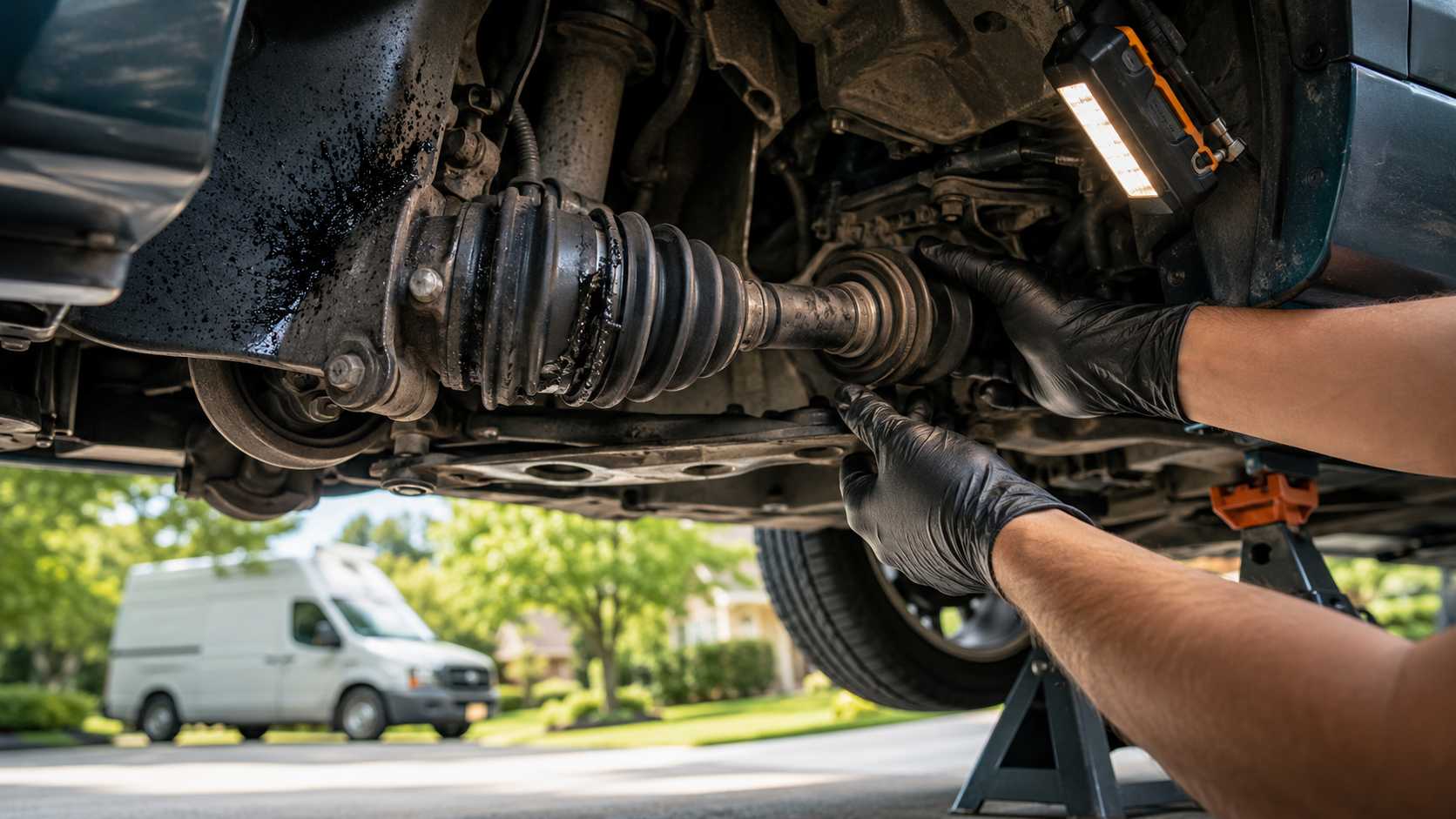
Each CV axle has two CV joints: an inner joint near the transmission and an outer joint near the wheel. Both are packed with special high-temperature grease and sealed inside a flexible rubber CV boot. That boot has one job — keep the grease in and keep road salt, water, and grit out. As long as the CV boot stays intact, the CV joint can run smoothly for well over 100,000 miles.

The trouble starts when the boot fails. Northern Virginia’s mix of salted winter roads, summer heat, and constant flexing eventually causes the rubber to crack. Once the CV boot tears, grease slings out, contaminants get in, and the CV joint begins to wear. That chain of events is behind the overwhelming majority of CV axle replacement jobs we perform.

The Symptoms of a Failing CV Axle

A bad CV axle doesn’t fail silently — it tells you in stages.

1. Clicking or popping when turning. This is the classic, unmistakable sign. A rhythmic clicking noise when turning — loudest during sharp, slow turns in a parking lot — means the outer CV joint has worn loose and developed play. The faster and harder you turn, the more pronounced the click. Once the clicking starts, the joint is failing and the axle needs to be replaced; re-greasing won’t reverse worn-out play.

2. Grease on the inside of the tire. A torn CV boot flings grease onto the inside edge of the wheel, the rim, and the underside of the car. This is often the very first sign, and the easiest to miss — but catching it early can mean addressing the problem before the CV joint itself is ruined.

3. Clunking when shifting or accelerating. A worn inner CV joint tends to clunk when you shift into drive or reverse, or when you accelerate from a stop. Some drivers describe it as coming from under the floor rather than the wheel.

4. Vibration that grows with speed. A damaged CV axle spinning slightly off-balance sends a vibration through the floor and steering wheel that gets worse as you speed up on I-66 or the Beltway. A bent or contaminated half-shaft is a common cause.

5. A growling or humming noise. If enough grease has leaked out, the dry CV joint can growl or hum at low speed from lack of lubrication.

What Happens If You Keep Driving on a Bad CV Axle

A failing CV axle never heals — it only deteriorates. Drive on a clicking, worn joint long enough and the half-shaft can seize or separate entirely, which leaves the car undriveable and you stranded, often at the worst possible moment. A failed CV axle can also damage nearby components and, in a severe case, lock up a wheel.

Catching the clicking early is the difference between a planned CV axle replacement in your driveway and a roadside breakdown plus a tow. If you’re also feeling looseness, wandering, or clunking in the front end, the issue may extend beyond the axle, which is why our steering and suspension repair covers the related components in the same visit.

How CV Axle Replacement Works

When a CV joint has worn to the point of clicking, replacing the entire CV axle assembly is almost always the right call rather than trying to rebuild a single joint. A complete half-shaft comes with both joints and both boots new, correctly greased and tested — which means consistent quality and no mismatched parts. Our techs remove the old axle, install the new assembly, and verify everything turns smoothly and quietly before the job is done.

If the boot is only just beginning to weep grease and the joint hasn’t developed play yet, we’ll tell you — sometimes you’ve caught it early enough that the axle still has life left. We won’t recommend a CV axle replacement you don’t need. If the noise turns out to come from something other than the axle, our car diagnostic service traces it to the true cause instead of guessing.

The Local Angle: We Diagnose It Where Your Car Sits

Most shops make you drive a clicking, vibrating car across town just to get it looked at — and that’s exactly the kind of driving that accelerates a failing CV axle. As an auto repair shop that comes to you, we inspect the CV axle, the CV boot, and both CV joints right in your driveway. We check for grease leaks, test for play in the joint, and pin down the source of the noise before anything is replaced.

That means a worn CV axle gets caught and replaced at your home or office anywhere in Northern Virginia — Fairfax, Arlington, Alexandria, Loudoun, and the surrounding areas — with the correct repair done the first time.

Frequently Asked Questions

Is it safe to drive with a clicking CV axle?

For a short time, yes — but not for long. A clicking CV axle is already worn, and it will keep deteriorating until the half-shaft fails. Driving on it risks being stranded, so get it inspected promptly so a simple CV axle replacement doesn’t become a breakdown.

A worn outer CV joint. When the CV boot tears and grease leaks out, the joint runs dry, develops play, and clicks during turns. The sound gets sharper the harder and faster you turn.

It varies by how worn the joint is, but every mile adds wear. Once the clicking starts, the CV joint is failing and the axle should be replaced soon to avoid being stranded.

If you catch a torn CV boot very early — before the joint develops play or starts clicking — a boot-only repair can sometimes save the axle. But once the CV joint is clicking, the joint is already worn and the full CV axle replacement is the lasting fix.

It means the CV boot has torn and is slinging grease as the axle spins. That’s an early warning that the CV joint is now exposed to dirt and moisture and will fail if it isn’t addressed.

Hearing Clicking on Turns?

We’re a Northern Virginia auto repair shop that comes to you. Our techs replace worn CV axles at your home or office — no driving a failing car across town. Book a CV axle inspection today.

Keep Reading

Car Vibrates When Accelerating: CV Axle or Something Else?

Car Vibrates When Accelerating: CV Axle or Something Else?

We're an auto repair shop serving Northern Virginia, and loose, vague steering is far more than an annoyance
Pothole Suspension Damage: Signs Northern Virginia Drivers Should Check

Pothole Suspension Damage: Signs Northern Virginia Drivers Should Check

We're an auto repair shop serving Northern Virginia, and loose, vague steering is far more than an annoyance
Why Do My Brakes Squeak Only in the Morning?

Why Do My Brakes Squeak Only in the Morning?

We're an auto repair shop serving Northern Virginia, and loose, vague steering is far more than an annoyance